Rain World’s New Player Experience Is Rough
Julian Sarkissian
Rain World holds a special place in my heart as one of the most rewarding and immersive games I’ve played, yet it launched in 2017 to mixed reviews from critics. Ever since, I’ve chalked it up to the critics being bad at the game, since 94% of the roughly 40,000 user reviews of Rain World on Steam are positive. But ever since the Downpour DLC update in 2023 introduced multiplayer to the game, I’ve been pulling my friends in to play with me, and I’ve seen well… mixed results. So I took a look back at those early critic reviews and started to see that they had some points. That got me thinking: how can Rain World’s new player experience be improved so I can get more of my friends to play it? I chose to evaluate this game with the GAP Heuristics. I’ll be considering the latest version of the base game, so not including Downpour. I’ll also be focusing on the Survivor character campaign, as that is the intended first experience.
The Tutorial
In Rain World, you play as a Slugcat who is lost in a post-apocalyptic world full of hostile creatures. Most simply, it’s a survival platformer where each day you forage for food, avoid creatures who want to eat you, and find shelter before a deadly rainstorm crashes down and kills you. That’s the gameloop at its core.
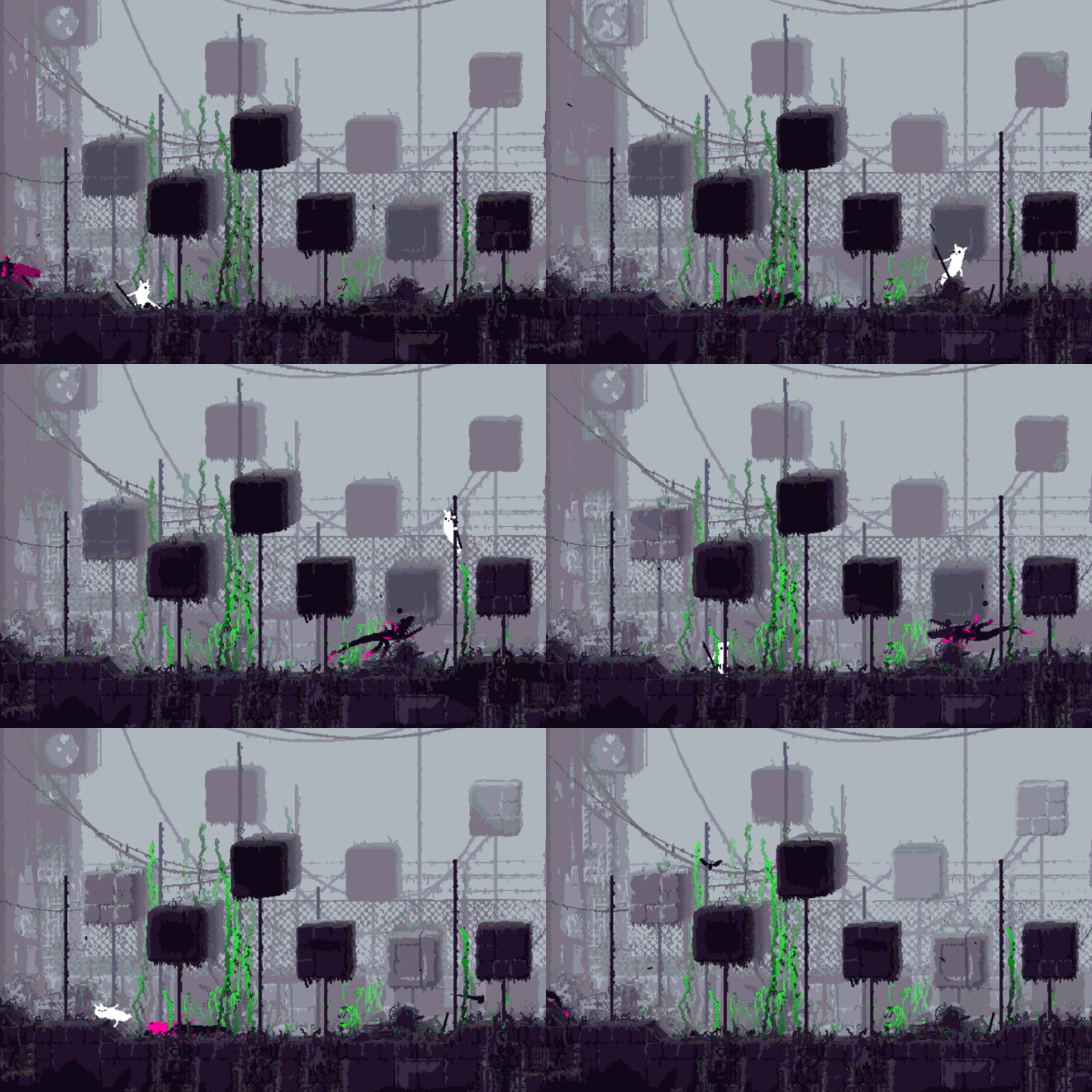
When you first boot the game, you get a cutscene showing how your character has been separated from their family (it’s kind of heart wrenching to be honest) and then you plop out of a pipe into the tutorial.
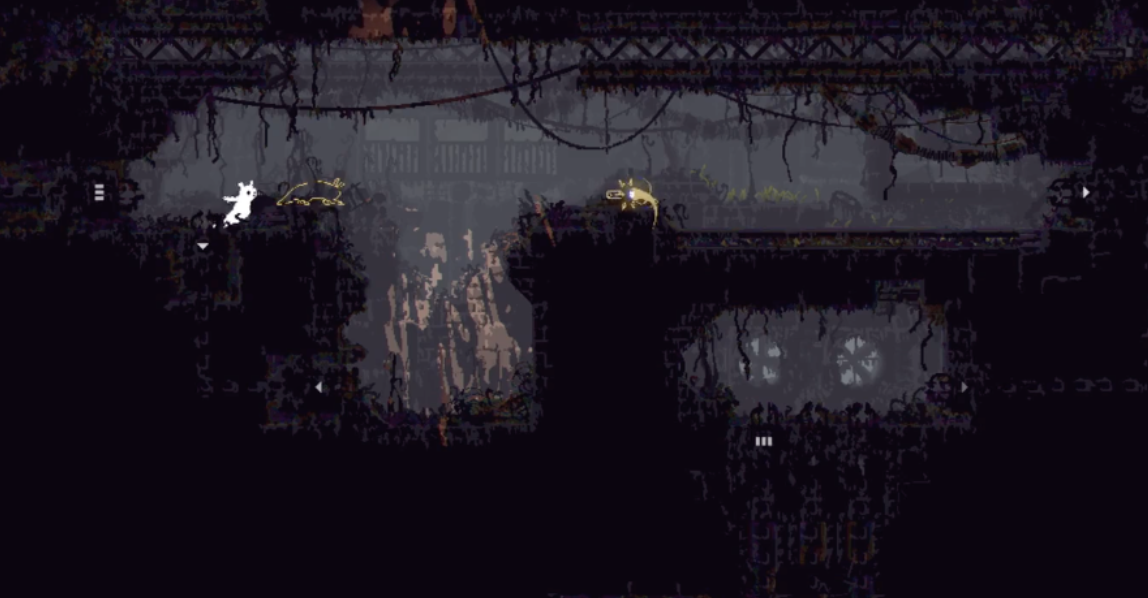
The tutorial is a good example of the first GAP heuristic: “The player is able to practice new actions without severe consequences.” The tutorial consists of a few rooms that teach you the basics: how to find and eat food, how much you need to eat to hibernate, how to climb poles, what shelter looks like, how to traverse rooms and pipes, and how to pick things up and throw them. All the rooms are void of enemies or death pits, and the deadly rain is turned off until right before you reach the shelter. But what I want to highlight here is the room that teaches you the leap jump. Here in this room you are taught via the overseer (the little yellow dude) how to perform the leap, and if you fail, you fall to the bottom of a pit with a pipe that leads right back to the top.
But this is where the good ends, because the tutorial doesn’t actually teach you much. In fact, the onus is on you to learn nearly everything else about the game. And as you do that, death is always looming around the corner.
After sheltering and completing the tutorial, you wake up and are taught that you can throw things, are given a rock, and then a few rooms later you meet your first lizard, a hungry beast that likes to eat Slugcats. Unlike with the jump before, there’s no safe space to practice throwing objects and hitting targets, you are thrust right into a life and death situation.
In some games, death may not be so punishing. In Celeste, when you die you respawn almost instantly in the same room where you died. But in Rain World, death can mean losing up to 6.5-13 min of progress; this is how long one cycle can last before the rain comes. And even if you die at the start of a cycle, with every death you lose karma (a means of progressing through the different regions of the game). Karma is only rewarded on a successful hibernation. All in all, death can be a severe punishment in Rain World.
This is basically what the rest of the game is like, learning out in the wild, which leads us right to our next GAP heuristic: “The player is given sufficient practice with new actions before they are punished for failing.” Rain World neither allows you to practice new actions without severe consequences, nor gives you enough practice before dishing out those consequences.
The Arena
But we’ve just been talking about the main campaign mode of the game. Does Rain World allow the player to practice in a different way? This is another one of our GAP heuristics. And the answer is yes, but with a huge catch.
In the base vanilla game, there is the Arena which has a Sandbox mode. In Sandbox, you can construct a custom one-room arena, placing enemies, food, weapons, and other items to your heart's content. It has a ton of customization options, like how long the rain is, what the win condition is, the difficulty of enemy AI, etc.
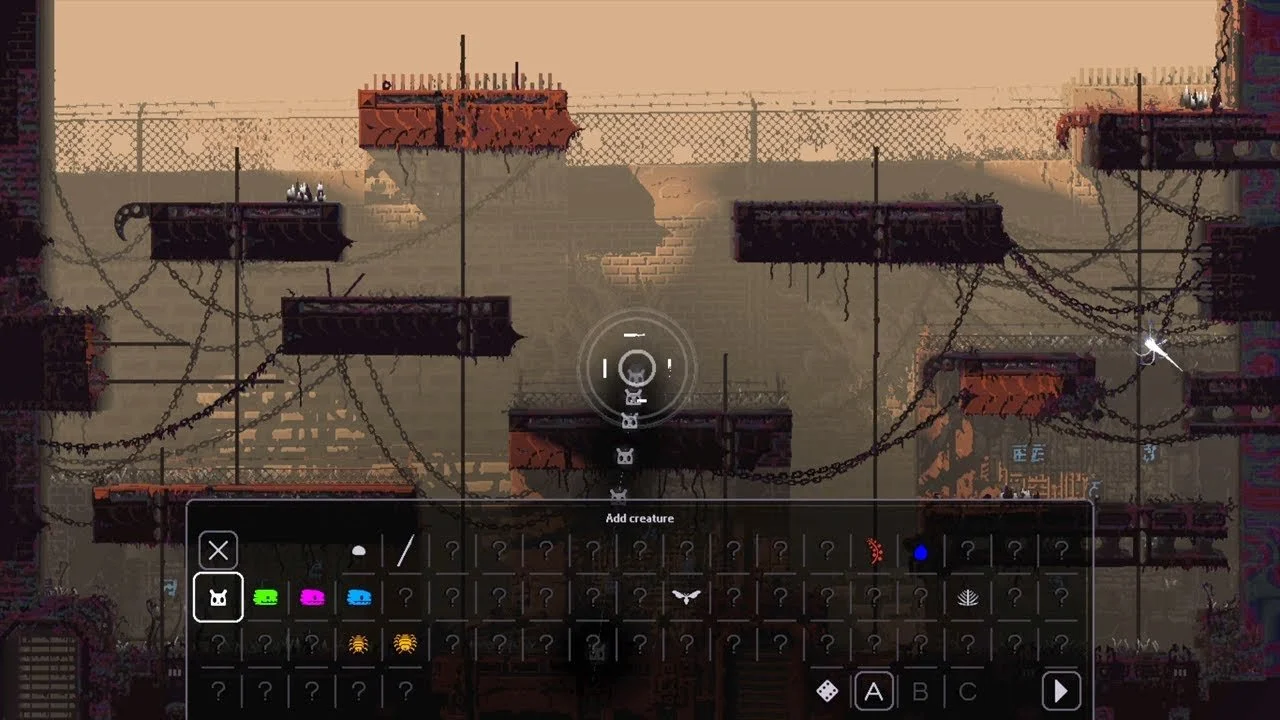
But the humongous catch is… you have to unlock the things you can place into the arena before you can use them in Sandbox mode. Huh?! These unlocks are found in the main campaign mode, usually in the regions where you first encounter the enemy/item, but often these unlocks are treated as rewards, making you take a risk to get them. One example: the unlock for the Rot, one of the trickiest enemies in the game, is right before the end of one of the hardest sections in the game. And the worst part, you are first introduced to this enemy two regions before you can even attempt to get the unlock. And then when you do reach the unlock, it’s in a room littered with the very enemy you’re trying to unlock. So by the time you get the unlock you are kind of already an expert on this enemy, and so there really isn’t any point to practicing in the Sandbox.
The cherry on top is that since the game is open world, you could just have gone a different way (also filled with this enemy, mind you) and missed the unlock entirely.
The game gives you five unlocks by default: the two lizards you encounter in the first region, a batfly (food), a rock, and a spear. The sandbox is useful for brand new players, but quickly becomes of questionable usefulness depending on whether you have the relevant unlocks. Given that you can often miss unlocks by going down alternate paths, or that some unlocks are treated as rewards, this isn’t a reliable way to practice against new enemies and with new items as you encounter them.
Post-Tutorial
The next GAP heuristic I want to discuss is whether “the player knows what actions they are supposed to perform and the consequences for completing or failing these actions.” After the tutorial, the player has a general understanding of what they’re supposed to do in order to survive. Find food, find shelter, avoid the rain, hibernate, repeat. The consequence of not finding food is explained: you can’t hibernate. The consequence of not finding shelter is implied: the rain will kill you. But other than that, the player isn’t really told what they are supposed to do.
The little yellow thing in the tutorial, the Overseer, is supposed to be showing the player which way to go to progress through the intended path of the game, but their clues are so cryptic that it’s easy to just wander off. This is what happened to me, and as far as I remember, my Overseer just stopped showing up at some point and got replaced by blue Overseers who were even less helpful. And of course, I didn’t know what the consequences would be for not following the Overseer, so when I eventually couldn’t progress, I looked up where to go online.
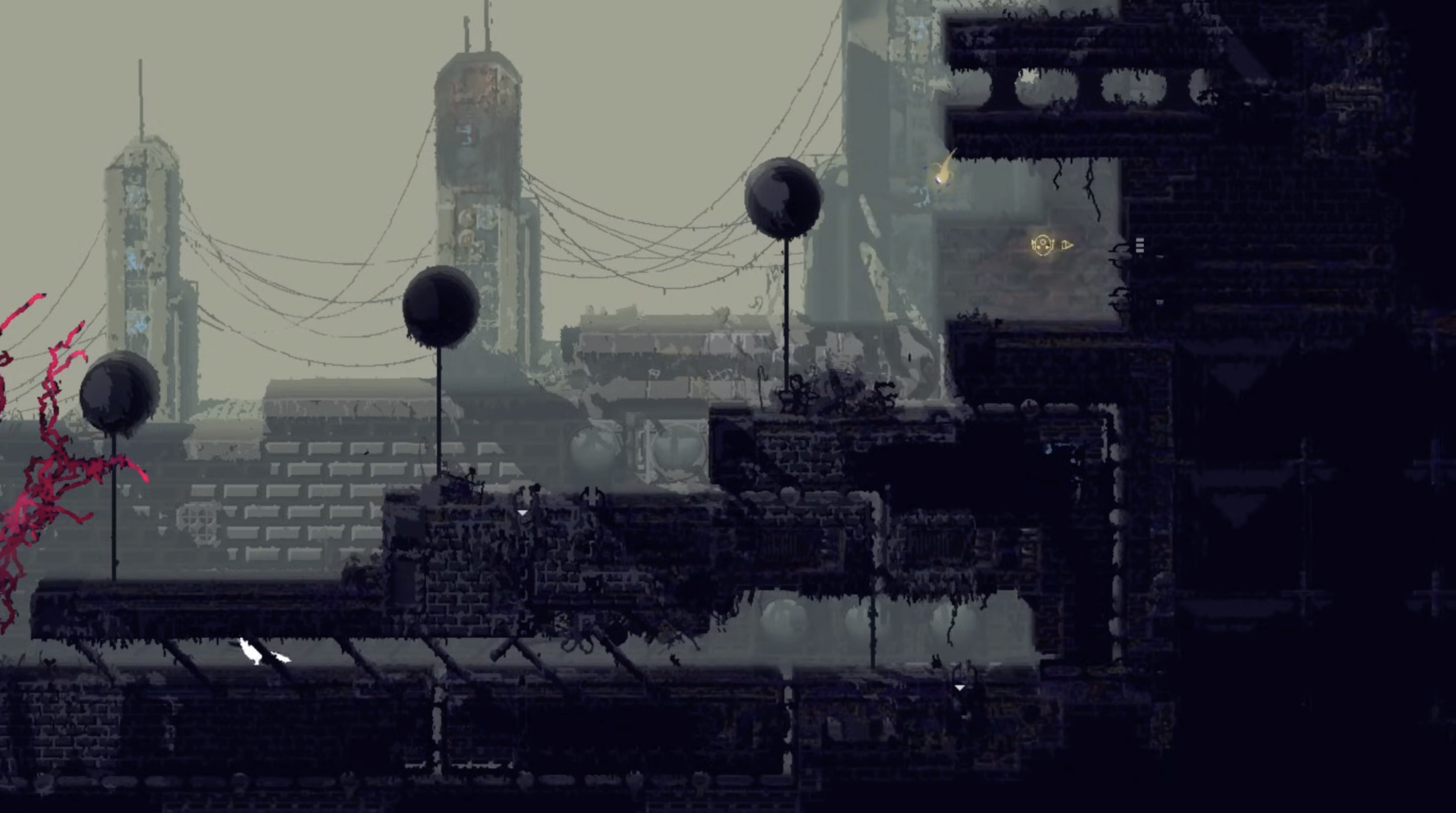
So all in all, Rain World does not communicate what you’re supposed to do or the consequences very well. And the tutorial is not enough to prepare players for success in the game. This is our next GAP heuristic.
I’m used to having to figure out stuff for myself, and I actually enjoy that process, so I thought the tutorial was good enough when I was first playing. But even in my experience, I eventually had to look things up, and I believe for the average player, it would be worse. I don’t think there’s any shame in looking into a game’s Wiki for help, but
I think a big part of why the tutorial isn’t effective is that players are bringing in knowledge and expectations of what Rain World will be like from other games in similar genres. But I will explain that this knowledge transfer is limited and can be misleading and may lead to error and frustration. And this is in fact another GAP heuristic. “The game is similar to other games of a similar genre and platform and games in the same series.”
In Rain World’s description on Steam, it calls itself a “survival platformer.” It is similar to these kinds of games, but differs in key ways that I believe create huge misunderstandings and frustration.
Let’s tackle the survival piece first. Now, I don’t really know too much about survival games, so let’s go based off of the Wikipedia definition: “Survival games are a subgenre of action games which are often set in hostile, intense, open-world environments. Players generally start with minimal equipment and are required to survive as long as possible by finding the resources necessary to manage hunger, thirst, disease and/or mental state.” And Rain World pretty much fits the bill. Hostile open world environment, check. Finding and managing resources, check. Limited initial equipment, check.
Rain World’s platformer identity is more problematic. Rain World takes the difficulty, punishment, and precision of hard platformers like Celeste and Super Meat Boy and sticks a mushy and unintuitive control system into it. Yes you can jump, walk, climb, etc, but all movement relies heavily on procedural animation and physics simulation. For someone who is not familiar and experienced with Rain World’s controls, it can feel like you are simply suggesting what the slugcat should do instead of actually making it do what you want.
As an example, depending on where exactly your body is positioned above or next to a pipe, you will slip into it head-first or tail-first. If you enter a pipe tail-first and want to move in the direction of your tail, your character will fold into itself and get clogged. To get yourself unstuck you have to spam the jump button, but this takes a few seconds. If a lizard is chasing you, you likely don’t have a few seconds before you die.
For a generation of gamers who have been trained on Mario, this is extremely dissonant with our experience. Entering a pipe should be as simple as walking next to the pipe and pressing the direction the pipe is going.
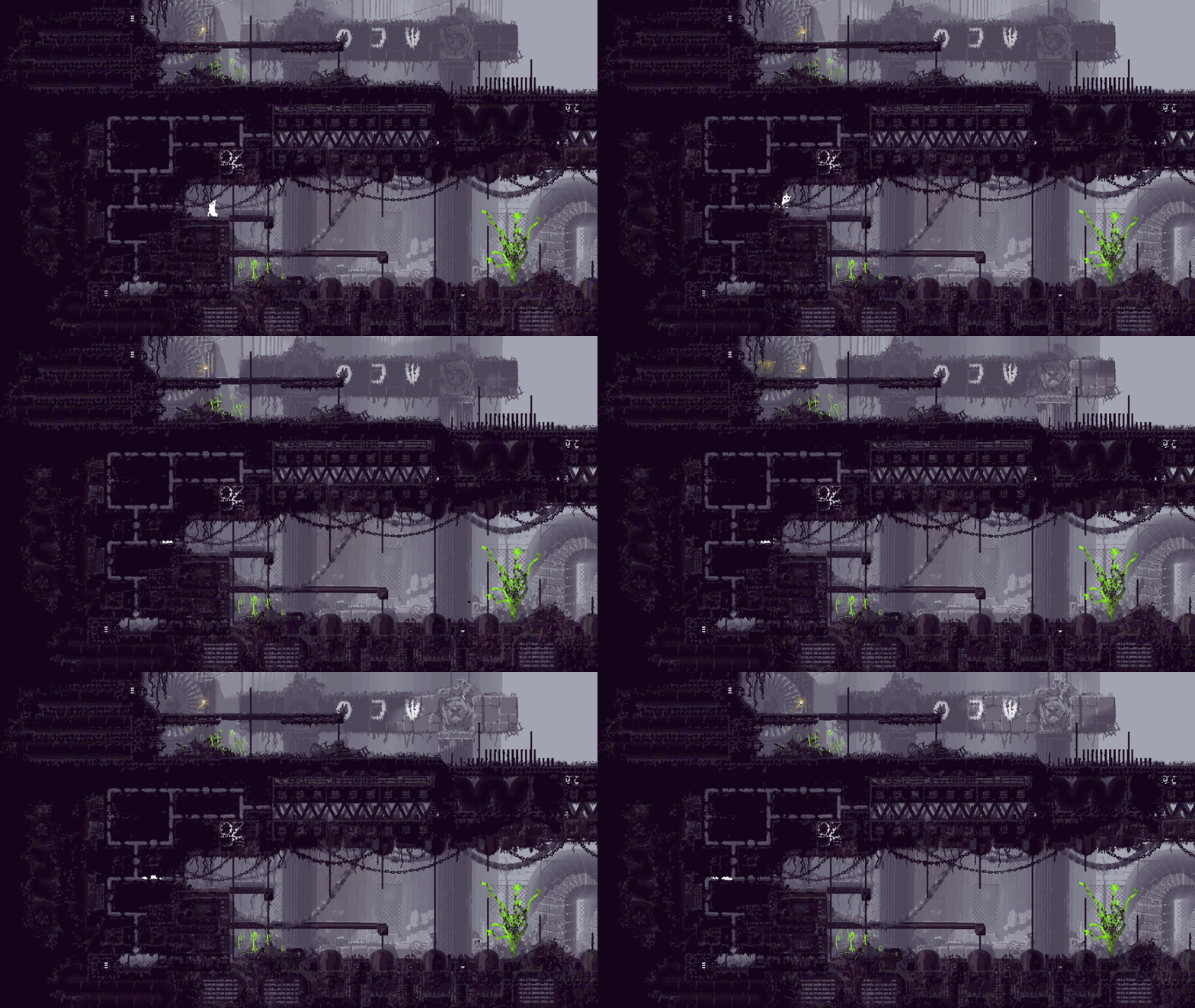
Other frustrations include rolling when you didn’t mean to, or crouching when you didn’t mean to. And sometimes you will get caught in little divots in the terrain geometry. Since it is not always clear what will result from a player input, you have to constantly be reacting to your own character and correct its own positioning. This is not something that someone familiar with traditional platformers would expect, and it is not something the game warns you about.
Rain World’s tutorial does not help ease the pains of this control system or help the player understand how the physics-based movement works. This is all info I had to glean from the internet. It doesn’t try to prevent the players from making those common errors mentioned above. This is a bonus heuristic, coming from Neilson’s, but I think error prevention is the main thing that Rain World fails at, and is what leads to a lot of new player frustration.
As Kenny McKee wrote in a review of the game all the way back in 2017 when it first came out: “Rain World is very much a game about players rescuing themselves.”
This is true with the controls, which require you to quickly adjust when an input you made didn’t really do what you expected. This is true of the core systems of the game, like the karma gates system, where it’s up to you to figure out what it means and how you can progress. And this is true of the goal and win condition, which is up to the player to deduce on their own.
Conclusion
Rain World is hard to get into for new players because it asks a lot of you and then punishes you severely when you mess up. It rarely lets you practice and learn new actions without severe punishment. It locks multi-modal practice behind unlockables. It gives you little and cryptic information and direction. It has a control scheme that breaks platformer expectations, but is never explained. And this general lack of explaining leads to player-error that the game never bothers to help correct.
In recent updates Rain World has attempted to fix some of these issues with the Remix Options. These are essentially accessibility and quality of life options that the player can toggle. The biggest of these being a tip system that doles out information about the game every time you load a new cycle. I won’t go into detail about this system here, but overall to me it’s a band-aid to the bigger issue of the game being too hands-off.
Despite all of this, it seems that thousands of other people still loved the game, including me. So how did I get past all of this, and love the game?
I think it is precisely that the game is so hands off that is what captured me, that I was so responsible for saving myself. To me, it felt amazing for a game to trust me this much. But I can imagine how it may feel neglectful and frustrating to others.
One of my fondest memories in Rain World happened near the start of my playthrough. I had no idea what the Overseer was telling me, so I went through the first Karma gate that I encountered. This took me into Drainage System, an underground area filled with water-logged pipes with few pockets of air and leeches and amphibious lizards. This was very much not the area I was supposed to be in, but I didn’t know that at the time. A bit of a way into the region, I was confronted with a swimming challenge. There were a bunch of leeches in the water that would cling on to me and drown me before I could reach the next pocket of air. I kept trying again and again but had no luck. And every time I respawned I started in this room with these beetles that would pop and stun me if I got close – super annoying – but then I had an idea. What if I used the popping bug to stun the leeches so I could progress? And it worked! I felt like a genius.
So what I’m trying to say is that Rain World’s hands-off approach made progressing through the game more rewarding for me than it was frustrating.
If the game wants to stick to its guns and give the player very little information, it should at least tell this to the player, and provide some advice on how to best approach uncovering its own mysteries. Or the more obvious choice, just give players more info, especially about the intricacies of the controls and error prevention stuff. And make the Overseer hints more obvious.
Some people believe that if Rain World became more hands-on, the charm of the game would be tarnished. Right now Rain World’s new player experience is rough, and I’m sure that was the intention, but I believe it is possible for Rain World to keep the intended charm of its mysterious world, while still better preparing the player for it and better guiding them through it.